
Spoiler warning: This post discusses major plot twists and the ending of Rebecca by Daphne du Maurier.
I recently finished Rebecca by Daphne du Maurier, and it was not quite the ghost story I expected it to be. Based on the description on the back of the book—and even the cover—I thought Rebecca’s ghost might literally haunt the new Mrs. de Winter. In a way, Rebecca does haunt her, but it isn’t paranormal. She haunts her through people’s memories, constant comparisons, and the expectations left behind at Manderley.
The narrator is never given a first name. Even before she marries Maxim, she doesn’t have much of an identity or a lot of confidence. She mainly accepts what other people tell her to do and seems grateful for whatever life gives her. She goes from working for the overbearing Mrs. Van Hopper to marrying Maxim and becoming the new mistress of Manderley, but she still lets everyone around her control how she lives. She has some interests, such as painting and taking walks, but most of her identity becomes being Maxim’s wife and the new Mrs. de Winter.
That is especially difficult because everyone at Manderley seems to have an opinion about how Rebecca did things. Rebecca preferred this room. Rebecca served food this way. Rebecca handled the house a certain way. The narrator is allowed to have her own opinions, but she is so afraid of upsetting anyone that she rarely expresses them. She doesn’t just live in Rebecca’s former home—she lives in her shadow.

She does eventually grow more of a backbone, especially when dealing with Mrs. Danvers and Jack Favell. However, she still walks on eggshells around Maxim and sometimes babies him. Maxim is much older than her and frequently talks to her like she is a child. His behavior toward her is also very hot and cold. Learning the truth about Rebecca explains some of his behavior and why he initially tried to push the narrator away, but it still made me question their relationship. When he asks whether she ever really loved him, I couldn’t help wondering whether he truly loved her either or if he mostly didn’t want to be alone.
I suspected early on that Maxim either wasn’t over Rebecca or had killed her, so the reveal that he killed her didn’t completely surprise me. The reasons behind it did, though.
Rebecca is initially described as almost perfect. She was beautiful, confident, capable, and seemingly loved by everyone. Once Maxim explains what their marriage was really like, that image falls apart. Rebecca comes across as someone who only cared about herself and treated everyone else like a pawn in her game. After learning that she had uterine cancer and couldn’t have children, she told Maxim that she was pregnant with another man’s child and that he would have to raise it as his heir. It seems like she deliberately provoked him because she knew what he might do.
That doesn’t make killing her right, but it does explain how trapped and broken Maxim felt. When he finally tells the narrator the truth, we also see his insecurity. He believes she will leave him once she knows what he did. Rebecca had clearly done a lot of damage to him, even though he tried to hide it.
Then there is Mrs. Danvers, who is honestly just completely obsessed with Rebecca. Her entire identity seems to revolve around having been Rebecca’s maid and being needed by her. Her grief has become something unhealthy and dangerous. She insists that Rebecca will always be the only Mrs. de Winter and even tries to convince the narrator to jump from a window. By the end, it is strongly implied that Mrs. Danvers burned Manderley after disappearing.
Manderley itself didn’t feel like a character to me, but it was an important setting with a lot of history attached to it. It meant so much to Maxim that he married Rebecca partly because she appeared capable of protecting the family’s reputation and managing the estate. In the end, he sacrificed so much for Manderley only to lose it anyway.
The mystery and pacing were probably my favorite parts of the book. There were constant developments that made me want to continue: Maxim refusing to visit the seaside cottage, Rebecca’s boat being discovered, the truth about her death, the inquest, Favell accusing Maxim of murder, and the visit to Rebecca’s doctor. Each answer created another question.
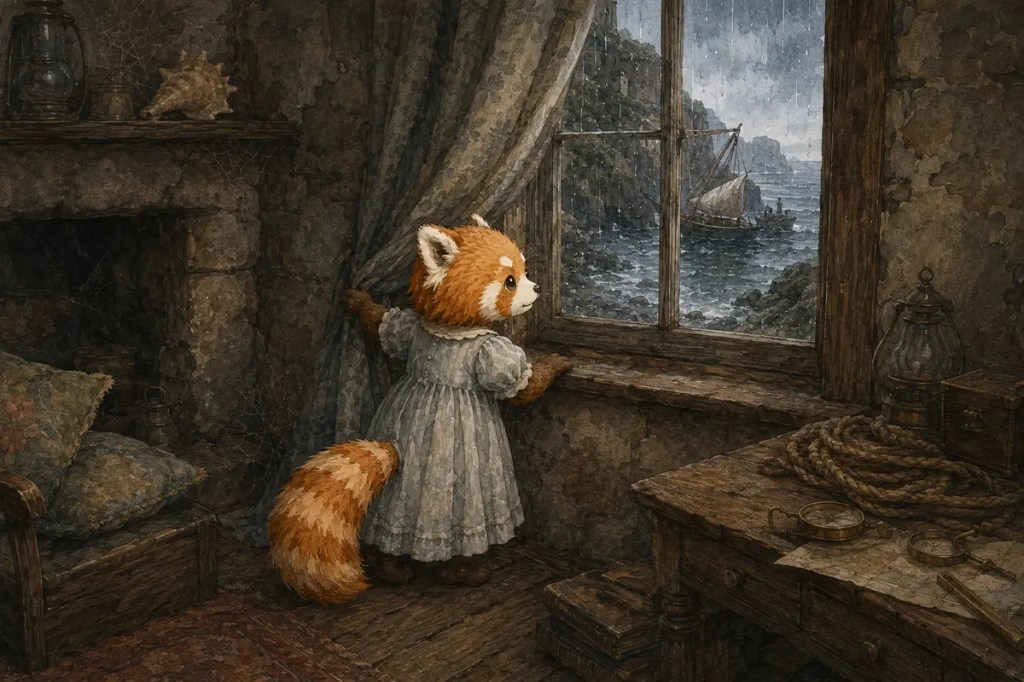
The visit to the doctor was especially effective because Favell expected the doctor’s records to prove that Rebecca was pregnant. Instead, they revealed that she had cancer and couldn’t have children. That gave the investigator a believable reason to accept the original suicide verdict. Then, just when everything involving Rebecca seems resolved and Maxim and the narrator might finally have a life together, they return to find Manderley burning.
The ending fit the story, although it wasn’t a completely happy ending. Maxim and the narrator are finally free from Rebecca’s influence in some ways, but they lose Manderley. The dreamlike opening chapter shows that they continue living with what happened there, so Rebecca and Manderley never entirely disappear from their lives.
For a novel published in 1938, Rebecca was surprisingly readable. Some words and attitudes clearly reflect the time, such as repeatedly using “gay” to mean happy. Giles also paints his face as part of a sheik costume, which is another moment when you have to remember when the book was written. The way marriage and gender roles are presented can also feel dated. Still, the vocabulary and overall storytelling didn’t feel as old as I expected.
I don’t normally read this kind of romance and psychological mystery, so I wouldn’t place Rebecca among my personal top ten books. However, it was a good read, and I genuinely wanted to keep reading because I needed to understand what really happened to Rebecca. I also wanted to know whether the narrator would ever stand up for herself.
I don’t personally like using star ratings because everyone experiences books differently. What works for me may not work for someone else. Still, I would recommend Rebecca to readers who enjoy mysteries, complicated relationships, gothic settings, and stories where someone’s presence can haunt every page without an actual ghost ever appearing.


Leave a comment